
 e.Soft Technologies - Software Development Companye.Soft Technologies - Software Development Company


Companies today rely heavily on software tools to manage business, finances, clients, and internal processes. As the companies grow, managing through these disconnected tools becomes inefficient. This is where business management solutions such as ERPNext and Zoho One come to the rescue.
Both platforms simplify operations and bring different departments into one ecosystem.
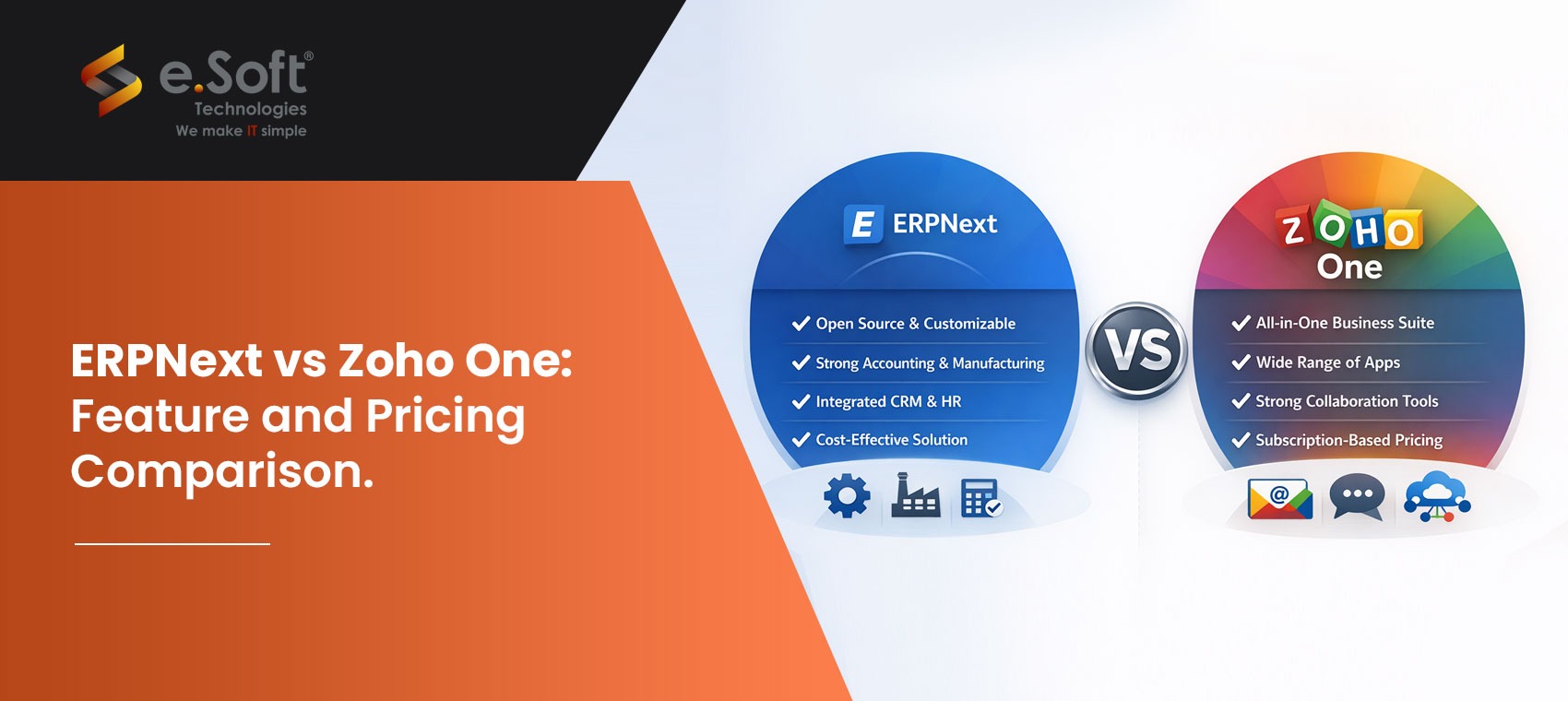
However their approach to business management is very different. Zoho One specializes in offering a series of various applications, and ERPNext is a single ERP platform, which deals with the end-to-end business operations in one system.
When companies are evaluating which platform is more appropriate to them, it is necessary to understand the differences in features, prices, scalability, and the operational depths.
ERPNext is a comprehensive enterprise resource planning system designed to manage core business functions such as accounting, CRM, HR, inventory, manufacturing, and projects from a single platform. Unlike traditional software suites that require multiple applications, ERPNext brings everything into a unified system with a single database and integrated workflows.
Such integrated architecture assists the companies to have real-time visibility in the operations. For example, the sales order creation links automatically with inventory levels, production planning, financial records and customer management.
ERPNext is open-source and implies that businesses are free to fully customize the system or run it in their own infrastructure or even to the extent it can be integrated with other tools based on their business requirements.
For organizations that require deeper operational control, especially in manufacturing, distribution, or logistics, ERPNext offers modules such as multi-level bill of materials, production planning, work orders, and supply chain management.
Thinking of implementing ERPNext for your business?Explore how our team helps companies deploy and customize ERPNext
Zoho One does not follow the same strategy. It is not an individual ERP system but a package of over 40 business applications in the fields such as CRM, accounting, HR, marketing automation, email and collaboration applications.
Zoho is an ecosystem consisting of applications that operate as an independent application and integrate with other applications. Depending on the need of operation, businesses have the option of the type of applications they prefer.
Although this model is effective with small groups that desire individual applications to carry out marketing, customer management, or the process of communication, it usually leaves companies with disjointed workflows whenever companies attempt to coordinate intricate operations like manufacturing, supply chain strategy, or inventory optimization.
In such cases, businesses may find themselves switching between multiple applications instead of operating from one centralized system.
The main difference between ERPNext and Zoho One lies in their architecture and operational focus
| Feature | Feature | Feature |
| Platform Type | Unified ERP system | Suite of multiple business apps |
| Core Modules | Accounting, HR, CRM, manufacturing, inventory, projects | CRM, marketing, HR, email, finance apps |
| Manufacturing Capabilities | Advanced features like BOM, MRP, production planning | Limited manufacturing functionality |
| Customization | Fully customizable open-source framework | Customization through Zoho Creator and add-ons |
| Deployment | Cloud, on-premise, or hybrid | Primarily cloud-based |
| Data Integration | Single database across all modules | Multiple apps integrated together |
| Scalability | Suitable for complex operational workflows | Best suited for service-focused businesses |
ERPNext is especially effective in operational management. It includes capabilities for inventory monitoring, production planning, and financial consolidation. Zoho One, on the other hand, is more oriented towards sales, marketing, and collaboration tools.
ERPNext tends to offer greater operational control where a business has a supply chain, a multi-warehouse operation, or deals with physical products.
Pricing Comparison
Pricing is another area where the two platforms differ significantly.
Zoho One follows a subscription-based business model to charge per user on a monthly basis. On the basis of the pricing plan, the companies can pay between 30 and 50 dollars per user per month.
The total subscription fee will rise in direct proportion to the number of organizational units and the number of employees who will need to access the system.
ERPNext works in a different manner. It is open source, and thus, the software itself is not paid a license fee by the businesses. The major costs include hosting, customization and implementation services.
This costing model allows ERPNext to be especially appealing to growing businesses where the business requires an expanded system without additional per-user expenses.
| Platform | Pros | Cons |
| ERPNext | Unified system with all modules in one platform | Implementation requires ERP expertise |
| Highly customizable open-source architecture | Initial setup may take planning | |
| Advanced manufacturing and inventory capabilities | Training may be needed for new users | |
| No per-user licensing cost |
|
|
| Zoho One | Large ecosystem of apps | Multiple applications instead of one ERP |
| Quick setup for basic workflows | Costs increase with team size | |
| Strong CRM and marketing tools | Limited operational depth for manufacturing | |
| Good for small service businesses | Fragmented data across apps |
This comparison explains the reason why many businesses favor ERPNext as an operational platform that is centralized rather than several tools that are independent.
Looking for ERPNext implementation support? See how e.Soft Technologies helps businesses implement ERPNext successfully
For growing companies, the biggest challenge is not just managing customers or communication but controlling operations efficiently.
Manufacturing planning, inventory tracking, financial consolidation, and procurement management require systems that are tightly integrated. ERPNext addresses these requirements by bringing all operational data into one system rather than spreading it across multiple applications.
Because ERPNext is open-source, organizations can also enjoy the full ownership of their data and have the flexibility to make changes to the platform based on the changing business needs.
This is very useful when businesses grow and the processes grow much more complicated.
While ERPNext offers powerful capabilities, successful implementation depends heavily on choosing the right implementation partner.
Proper system configuration, workflow customization, data migration, and user training play a critical role in ensuring the ERP system delivers the expected value.
This is where experienced ERPNext implementation partners can make a significant difference.
Companies like Esoftech specialize in helping businesses implement ERPNext based on their specific operational requirements. From system setup and customization to training and ongoing support, the goal is to ensure organizations fully leverage the platform’s capabilities.
ERPNext and Zoho One are both useful solutions to companies that need to modernize their operations. Their design philosophies are however very different.
Zoho One focuses on providing a collection of applications for different business functions, while ERPNext delivers a unified ERP system designed to manage the entire business lifecycle from a single platform.
ERPNext has a tendency to be a more robust solution in the long run in organizations that need deeper operational visibility, manufacturing management, and infrastructure that can be scaled.
With the right implementation partner to lead the process, the businesses will have an opportunity to realize the full potential of ERPNext and develop a more connected, efficient, and scalable operational system.

Yes, ERPNext is widely used by small and medium-sized businesses because it offers a complete ERP system without high licensing costs. Companies can manage accounting, inventory, HR, CRM, and operations within one platform, which helps growing businesses streamline their workflows and scale operations more efficiently.
The cost of ERPNext implementation depends on factors such as company size, number of users, customization requirements, and hosting preferences. Since ERPNext is open-source, businesses usually pay for implementation, customization, training, and support rather than software licensing fees.
Yes, ERPNext supports integration with various third-party tools including payment gateways, e-commerce platforms, CRM tools, and other business applications. This flexibility allows companies to connect ERPNext with their existing digital ecosystem without disrupting their current workflows.
ERPNext implementation timelines can vary depending on the complexity of business processes. Small businesses may complete implementation within a few weeks, while larger organizations with multiple departments and custom workflows may require a few months.
ERPNext supports both cloud and on-premise deployment options. Businesses can host the system on their own servers, choose a cloud hosting provider, or use managed ERPNext hosting depending on their security, scalability, and infrastructure requirements.
Working with an ERPNext implementation partner can significantly improve the success of the deployment. An experienced partner helps with system configuration, data migration, workflow customization, and employee training to ensure the ERP system aligns with the company’s operational processes.
Are you seeking to contribute through your writing? Get in touch with us now!
Email Us!Warehouse Management Software
An eCommerce platform specializing in home improvement, home goods, and outdoor products, aims to serve as a comprehensive source for household essentials. Life and Home gained popularity, resulting in a substantial increase in orders from various platforms.

Life and Home partnered with e.Soft to develop warehouse management software. This innovative solution automated the entire workflow of their warehouse operations, particularly focusing on inventory management.
By streamlining processes and ensuring accurate inventory tracking, the software helped Life and Home fulfill orders promptly and minimize delays.
This collaboration underscored Life and Home’s commitment to leveraging technology to enhance operational efficiency and customer satisfaction in the competitive eCommerce landscape.
Software Development
Shia PG is one of the Premier institutions based in Lucknow. their vast education and management activities required sophisticated software for precision, punctuality, and accuracy. they needed this software to automate various activities of their education system. e.Soft supported them with manual processes with highly responsive and easy-to-use software.
To fulfil the client’s requirements, e.Soft designed and developed comprehensive software that automates end-to-end activities of the institution right from student admissions to generating iCards, all using its cloud-based system.
The software developed by e.Soft manages all the routine as well as complex activities with precision. It has simplified all the major detailed activities of the admission management system.
The administrative processes of the Shia P.G. College were enhanced with our automation software.
Joint Secretary Manager
Automated Cloud Security Compliance with Cloud RAXAK - RAXAK Protect
The National Payments Corporation of India (NPCI) is a leading organization in India, responsible for operating retail payments and settlement systems. Given the critical role NPCI plays in India’s financial infrastructure, maintaining a robust security posture across its cloud environments is vital for protecting sensitive data, ensuring regulatory compliance, and preventing unauthorized access.
Cloud Raxak has partnered with e.Soft since our founding in 2014. All our product development activities, and our web presence has been exclusively developed by the talented engineers at e.Soft.
Throughout our continuing engagement, e.Soft has been responsive to our changing skill-set needs ranging from Python development, front-end development, testing, and web management in a flexible and timely manner. We simply could not have developed a world-leading best-in-class security product, winner of the Gartner Cool Vendor award, and deployed at some of the most demanding financial sector companies without this support.
Thank you e.Soft!
CEO
Technical Support
ChannelSale equips online Sellers with cutting edge powerful software solutions and expert services for automating sync of product listings, inventory, orders across various eCommerce platforms globally via a single software interface. e.Soft offers technical support to their business.
With a wide range of technological solutions and a highly experienced team they delivered excellent technical support to our business. They met our demands by providing undivided attention and support and made sure our business was scaled up successfully.
CEO
Software Solutions
Infinity Group is a prominent leader in the automotive aftermarket products industry across West Africa. e.Soft provided Infinity Group with a tailored, all-in-one software solution designed to address their specific operational needs, like import and forex management, inventory management, complex operations, legacy systems, and more.
When Infinity Group was expanding its network of retail sales and service centers across Nigeria and Ghana, e.Soft stepped in with a much-needed robust system to manage its complex import, forex, and inventory operations.
e.Soft’s custom-developed software addressed these needsby automating processes, integrating critical business functions, and providing real-time data and analytics. This solution empowered Infinity Group to streamline their operations, reduce manual errors, and scale confidently across the region.
We’ve been working with e.Soft Technologies since September 2024, and it’s been a really smooth collaboration so far. Their team worked closely with ours and helped speed up both our app and website development. We’ve been able to launch features faster, improve stability, and give our users a better overall experience. They’re responsive, easy to work with, and quick to adapt whenever things shift. It’s been a positive experience, and we’re looking forward to continuing the partnership.
Co-Founder
